A diagnostic for decision-makers
The way you see risk shapes every decision — whether you know it or not.
Most people assume they weigh risk rationally. The evidence says otherwise. The Risk Type Compass®reveals the pattern beneath your judgment — the one that drives your behavior.
Delivered by consulting psychologists at Crescente Advisors and Contemporary Leadership Advisors, working with senior leaders and investment teams across asset management, private equity, life sciences, and technology.
The Instrument
Eight risk types. One coherent framework.
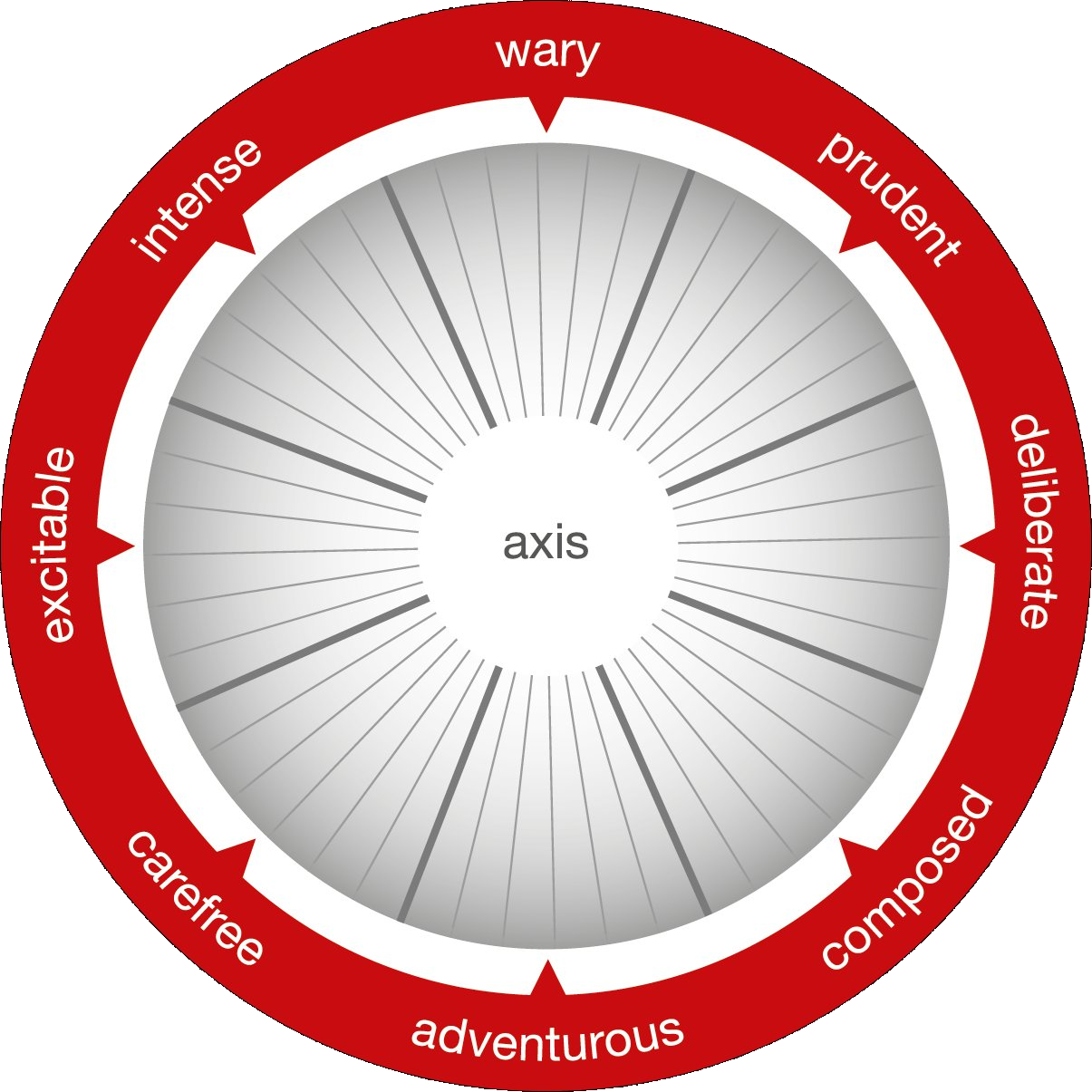
Risk Type Compass®is a psychometric assessment developed by Psychological Consultancy Ltd, registered with the British Psychological Society and validated against a normative sample of more than 13,000 individuals across twenty industry sectors. It maps each person onto a 360° spectrum defined by two independent neurological systems —emotion(how anxious or fearless we are in the face of risk) andcognition(how we tolerate uncertainty and make sense of complexity). The result is one of eight distinctive Risk Types.
-
-
This is not a personality test or a generic risk-tolerance questionnaire. It is a typology grounded in personality structure that predicts how a person will perceive, react to, and decide under pressure — patterns that show up consistently across decades, contexts, and stakes.
Risk Type allocation is non-judgmental. Every type carries advantages and challenges. The goal of the work is not to change anyone’s type — it is to make the pattern legible, so that individuals and teams can decide more deliberately.
Why it matters
Risk perception is highly individual — and most distorted at exactly the moment it matters most.
Two people looking at the same data rarely see the same risk. Under pressure, the gap widens. The cost shows up in less effective decisions that take longer to make, misjudged opportunities, and friction between colleagues and team members.
Without insight
- Teams misalign on the same data
- Decisions drift under pressure
- Opportunities get missed or misjudged
- Hires fail for reasons no one can name
With it
- Individuals decide more consistently
- Teams find faster, durable alignment
- Communication sharpens where it counts
- Composition matches the mandate
Our approach
Application, not just insight.
A report that sits in a drawer is worse than no report. The value isn’t in the assessment — it’s in what you do with it. Every engagement is built around real decisions, real teams, and the conditions under which they actually have to function.
- We analyze the decisions you’re actually making — not abstract scenarios.
- We map the patterns that emerge under pressure, when defaults take over.
- We translate insight into team and individual practice, with concrete next steps.
- We match team composition to the mandate — innovate, execute, or both.
Who this is for
Three scenarios, one underlying problem.
Whether you’re sharpening your own judgment, building a team that has to decide together, or hiring for a role where risk fit matters more than résumé — the work is the same.
Senior leaders making decisions with real downside.
You want to understand your own pattern before the next high-stakes call — the strategic pivot, the capital allocation, the hire that has to work. You’ve had your fair share of 360s. This one tells you something different.
Investment teams, boards, leadership groups, and operating committees.
The team keeps stalling on the same kinds of decisions, and you suspect it’s not about the data. PMs and analysts talk past each other on conviction, sizing, and selling. A team is struggling to innovate to meet new market realities. Or maybe some voices don’t get heard.
CHROs, chief investment officers, hiring managers, and talent leaders making composition decisions.
You’re hiring into a role where risk orientation matters as much as track record. Or you’re composing a team for a specific mandate — innovation, turnaround, scaled execution — and you don’t want to find out you got the mix wrong eighteen months in.
In practice
Three engagements. Three decisions that changed.
- Situation
Discussions stalled at conviction-to-size translation. PMs accused analysts of being too cautious; analysts felt their work was being ignored.
- Approach
Full-team Risk Type Compass®, mapped against role and decision authority.
- Insight
The PMs shared similar risk profiles; the analysts were more varied. The friction wasn’t analytical — it was structural.
- Outcome
A shared vocabulary for the disagreement — and how to leverage it for alpha.Protocols rebuilt around the actual gap. Meaningful improvement in portfolio performance and team dynamics.
- Situation
The leading candidate looked exceptional on paper but the team was already weighted toward caution.
- Approach
Final-round candidates assessed against role demands and existing team composition.
- Insight
The frontrunner’s profile was a strong match for the existing team — and a poor match for what the role actually required.
- Outcome
A different hire, with a complementary risk orientation.The new business line hit its first-year revenue plan; the leadership team reported markedly better debate quality.
- Situation
The team prided itself on diversity of thought but consistently produced consensus decisions that under-weighted downside.
- Approach
Whole-team assessment plus facilitated session pairing the data with three real recent decisions.
- Insight
The team had cognitive diversity but converged toward optimism under time pressure — a pattern invisible from the inside.
- Outcome
Decision protocols redesigned to require explicit downside framing before final vote. Two subsequent decisions reversed late based on this discipline.
How to engage
Four ways in. Pick the one that matches the question you’re asking.
Engagement scales from a self-serve assessment to fully bespoke team and organizational work. Most clients start with one tier and move up as the question gets sharper.
Assessment only
- Risk Type Compass® assessment
- Personalized written report
- Self-directed interpretation
Administering the assessment requires certification. Get certified →
Assessment with debrief
- Everything in Tier 01
- One 60-minute debrief with an expert advisor to understand practical application of insights from the report
Administering the assessment requires certification. Get certified →
Bespoke coaching
- Assessment plus three 60-minute sessions
- Triggers, blind spots, and calibration practice
- Concrete protocols for high-stakes calls
Team & organizational
- Whole-team assessment and mapping
- Workshops, hiring calibration, composition design
- Investment-team and leadership-team specializations
See what you get
Three reports. One framework, calibrated for the question you’re asking.
Every assessment produces a written report grounded in the same psychometric framework. The report you receive depends on what you’re trying to understand — yourself, your fit for a role, or how a team thinks together.
Who you’ll work with
A small bench, deeply credentialed.
-
Christine A. Scordato, Ed.M
Founder, Crescente AdvisorsFormer executive at Wellington Management and Putnam Investments, working with discretionary investors to identify and develop investment skill. Her practice at Crescente Advisors also includes venture capital firms, hedge funds, and allocators. Certified executive coach (Columbia) and International Systemic Team Coach (AoEC London). Harvard and Smith College. Long-time Fellow at the Harvard Institute of Coaching.
-
Dan Fisher, PhD
Managing Partner, Contemporary Leadership AdvisorsConsulting psychologist advising C-suite executives, boards, and investors on leadership and organizational challenges. Co-founder of Contemporary Leadership Advisors, formerly a founding member of AlixPartners’ Leadership & Organizational Effectiveness practice. PhD in Clinical Psychology, UC Santa Barbara; postdoctoral training at Weill Cornell. Co-author ofThe End of Leadership As We Know It(Wiley, 2023).
-
Alessa Natale, PhD
Senior Consultant, Contemporary Leadership AdvisorsIndustrial-organizational psychologist with prior roles in Talent Management at Johnson & Johnson and Learning & Development at Pfizer. Has taught I-O Psychology and Career Development at CUNY, where she earned her MS and PhD. Research focuses on the integration of leadership, development, and inclusion.
-
Liz Weglarz, MA, MBA
Senior Consultant, Contemporary Leadership AdvisorsCoaches leaders and teams through complex change, with a decade of experience across technology, consulting, healthcare, and non-profit sectors. Teaches motivation and leadership at Baruch College. PhD candidate in Industrial-Organizational Psychology at the CUNY Graduate Center. MBA, Stony Brook.
Read it on your own time
The full brochure. Twelve pages, no contact required.
Methodology, the eight risk types, what each report contains, how engagements are structured, and the questions clients ask before they buy. Designed to be read once and forwarded to a colleague.
Take the next step
Better decisions are a conversation away.
Whether you want to understand your own judgment, sharpen a team’s, or get a hire right — tell us what you’re trying to figure out, and we’ll help you find the right starting point.